Guide
Buying your first chronograph under €3,000
29 July 2026 · 7 min read
What you actually get for the money at this level, which movements to look for, and the running costs nobody mentions before you buy.
Under €3,000 the chronograph market splits into three groups: modern watches with a meca-quartz module, modern watches with an automatic Seiko or Sellita movement, and vintage pieces with a hand-wound calibre.
Meca-quartz gives you the snap of a mechanical reset with quartz accuracy and almost no maintenance. It is the most rational choice and the least romantic one. Expect €300 to €800.
Automatic chronographs at this price usually run a Seiko NE86, a Sellita SW510 or a Valjoux 7750 derivative. The 7750 is a workhorse with a distinctive wobble from the rotor; the column-wheel Seiko is smoother to operate. Service intervals of five to seven years cost €350 to €600 — budget for it before you buy, not after.
Vintage is where the value and the risk both live. A 1970s Landeron or Valjoux chronograph can be had for €1,200 to €2,500, but parts availability decides whether it will still be running in ten years. Ask when it was last serviced and by whom, and treat "running well" without paperwork as an unserviced watch.
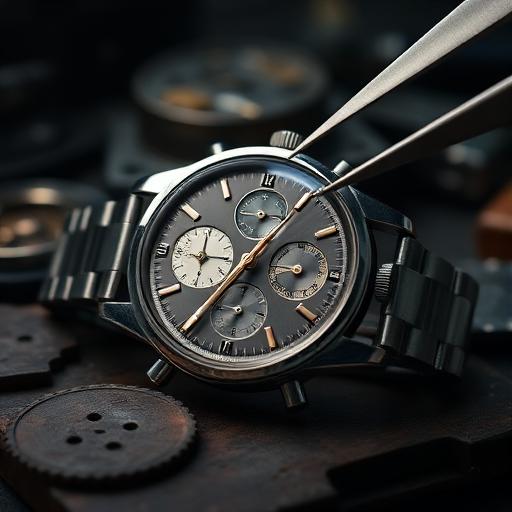
Whatever you choose, check the pushers before committing: they should engage with a defined click, the seconds hand should reset exactly to zero, and the chronograph should be able to run for an hour without the amplitude collapsing.
Finally, buy the condition, not the deal. At this budget an honest, serviced, unpolished watch at the top of your range will outlast three bargains.